What Is Go? The Board Game of Weiqi, Baduk and Igo Explained
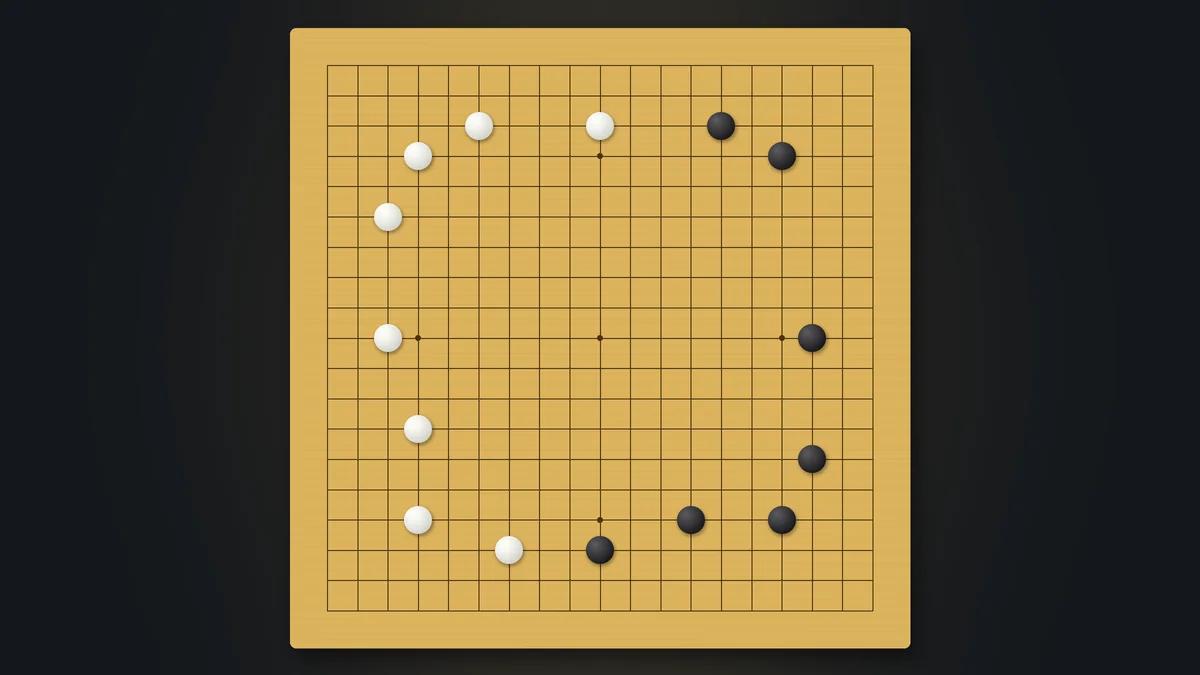
Go is a board game for two players. One plays with black stones, the other with white, and they take turns placing one stone at a time on the intersections of a grid. The aim is simple to say: finish the game controlling more of the board than your opponent. Everything else about Go, including its famous depth, grows out of that one idea.
The same game has several names. In China it is Weiqi (围棋), in Korea Baduk (바둑) and in Japan Igo (囲碁), usually shortened to Go, the name that English adopted. This guide explains what the game is, how it is played and why it has kept people's attention for more than two thousand years.
The board and the stones
A full-size Go board has 19 horizontal and 19 vertical lines, which gives 361 intersections. Stones are placed on the intersections, not inside the squares. Nine points are marked with small dots, called star points, which help players find their bearings.
A set has 181 black stones and 180 white stones. All stones are equal: there is no king, no queen and no piece with a special move. A stone never moves once it is placed. It stays where it is until the end of the game, unless it is captured and taken off the board.
Beginners usually start on a small 9 by 9 board, where a game takes about ten minutes, then move to 13 by 13 and finally to 19 by 19. The rules are the same on every size.
How the game is played
Black plays first, and the players then alternate. On your turn you may place one stone on any empty intersection, with two exceptions that are explained below, or you may pass. The game ends when both players pass in a row, which happens when neither sees a move that would gain anything.
Because Black has the advantage of moving first, White receives compensation points called komi. Komi is 6.5 points under Japanese and Korean rules and 7.5 points under Chinese rules. The half point prevents drawn games.
Liberties and capture
The empty points directly next to a stone, along the lines, are its liberties. A single stone in the middle of the board has four liberties, a stone on the edge has three and a stone in the corner has two.
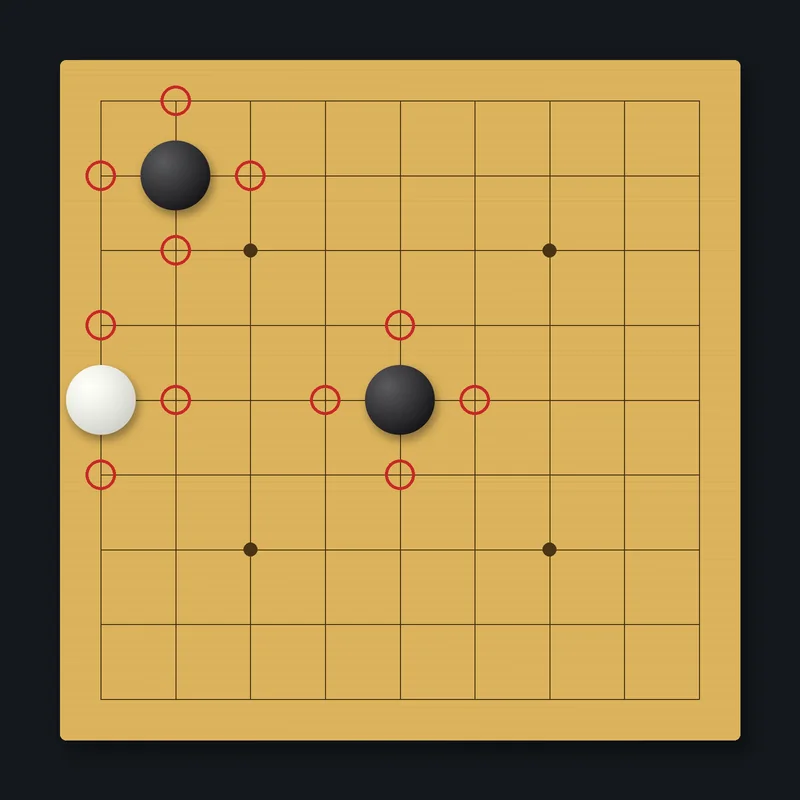
Stones of the same colour that touch along the lines form a group and share their liberties. When the opponent occupies the last liberty of a stone or a group, it is captured and removed from the board. A stone or group with only one liberty left is said to be in atari, a warning that it can be captured on the next move.
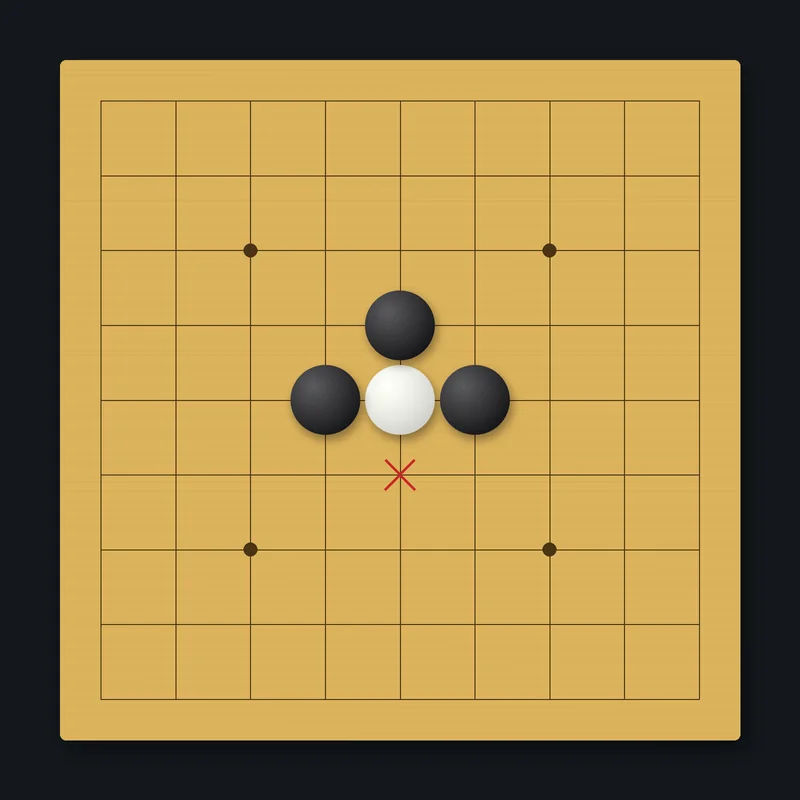
Two rules follow from this. First, you may not play a stone where it would have no liberties, unless that move captures something. Second, the ko rule: you may not make a move that recreates the position exactly as it was one move earlier. Without it, two players could capture and recapture the same stone forever.
Life, death and two eyes
If stones can be captured, how does any group survive? The answer is the most important idea a beginner learns. A group that surrounds two separate empty points, called eyes, can never be captured, because the opponent cannot fill both points at once and each one alone is a forbidden move. Such a group is alive. A group that cannot make two eyes and cannot connect to a living group is dead, even if it is still on the board.
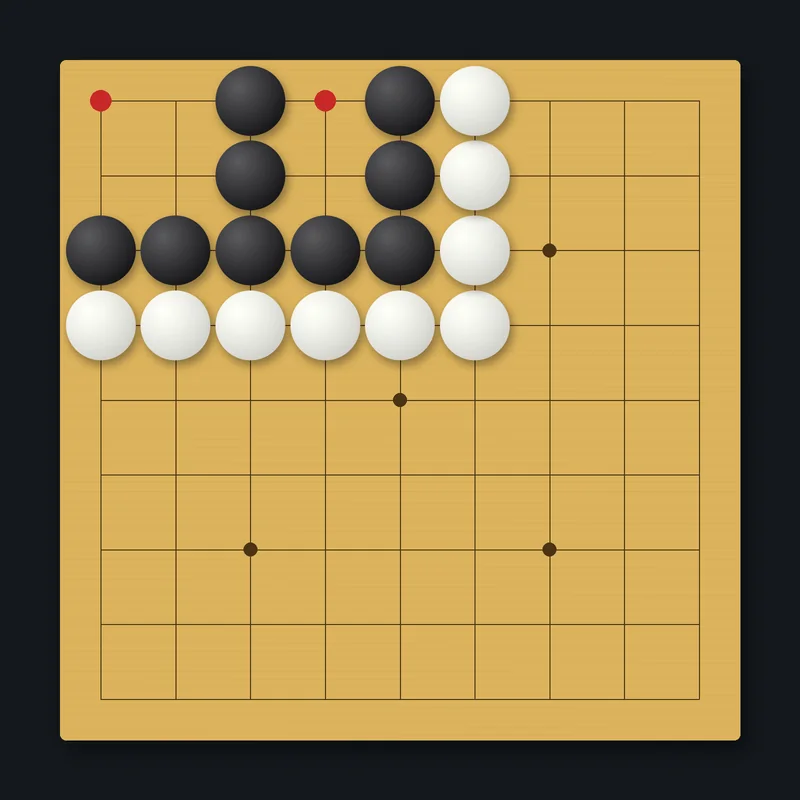
Much of Go is the practical question of whether a group can make two eyes. These are called life-and-death problems, and solving them is the classic way to train reading. You can practise them in the Life & Death Analysis section of weigok.
How the winner is decided
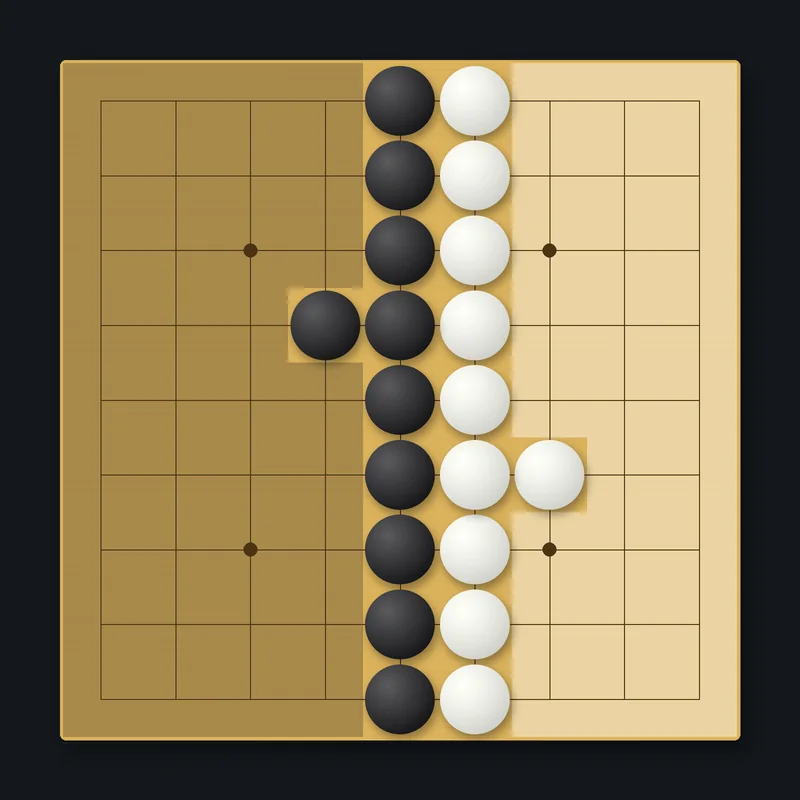
When the game ends, each player counts the empty points that their stones surround, their territory. Under Japanese and Korean rules, captured stones are added to the score. Under Chinese rules, the stones on the board are counted together with the territory. The two methods nearly always give the same winner. White adds the komi, and the player with more points wins.
A game can also end early. A player who sees no way to win may resign, which is the normal and polite way to end a lost game among experienced players.
Why such simple rules make a deep game
The rules of Go fit on one page, yet the game is far too large to calculate. The number of legal positions on a 19 by 19 board is about 2 followed by 170 zeros, more than the number of atoms in the observable universe. A typical game lasts around 250 moves, and at almost every turn there are many reasonable choices.
Because of this, strong players rely on judgement as much as calculation. They think about the balance between secure territory and influence, about which stones are worth saving and which should be given up, and about the whole board instead of one local fight. This is why Go resisted computers for so long. A program first defeated a top professional in an even match only in 2016, when AlphaGo beat Lee Sedol, nearly twenty years after a computer had beaten the world chess champion.
Go and chess
People often compare the two games. In chess the board starts full and empties as pieces are exchanged; in Go the board starts empty and fills up. Chess is about checkmating one king; Go is about sharing out the whole board, so a player can lose a battle in one corner and still win the game. Chess pieces differ in power; Go stones are identical, and their value comes only from where they stand in relation to the others.
Go also has a handicap system that chess lacks. The weaker player may place two to nine stones on the board before the game starts, which lets players of very different strength enjoy a fair game.
Ranks and levels
Amateur strength is measured in kyu and dan. A complete beginner starts around 30 kyu and counts down towards 1 kyu. Above that come the amateur dan ranks, from 1 dan upwards. Professional players have their own scale, from 1 dan to 9 dan, awarded by the professional associations of China, Korea, Japan and other countries.
Who plays Go
Go is played by tens of millions of people, most of them in China, Korea and Japan, where professional players compete for titles and the top matches are shown on television. It is also played in clubs and online on every continent, and the internet has made it easy to find an opponent of your own level at any hour.
How to start
You do not need talent or a teacher to begin, only the few rules above and a small board. A good path is to learn the rules step by step, play short games on 9 by 9, and solve easy capture problems.
On weigok you can do this on an interactive board that plays through each lesson move by move. Start with the first chapters of Learn Go, see the whole course in the Contents, and read How to Learn the Basics of Go for a step-by-step plan.