The History of Go: From Ancient China to the Age of AI
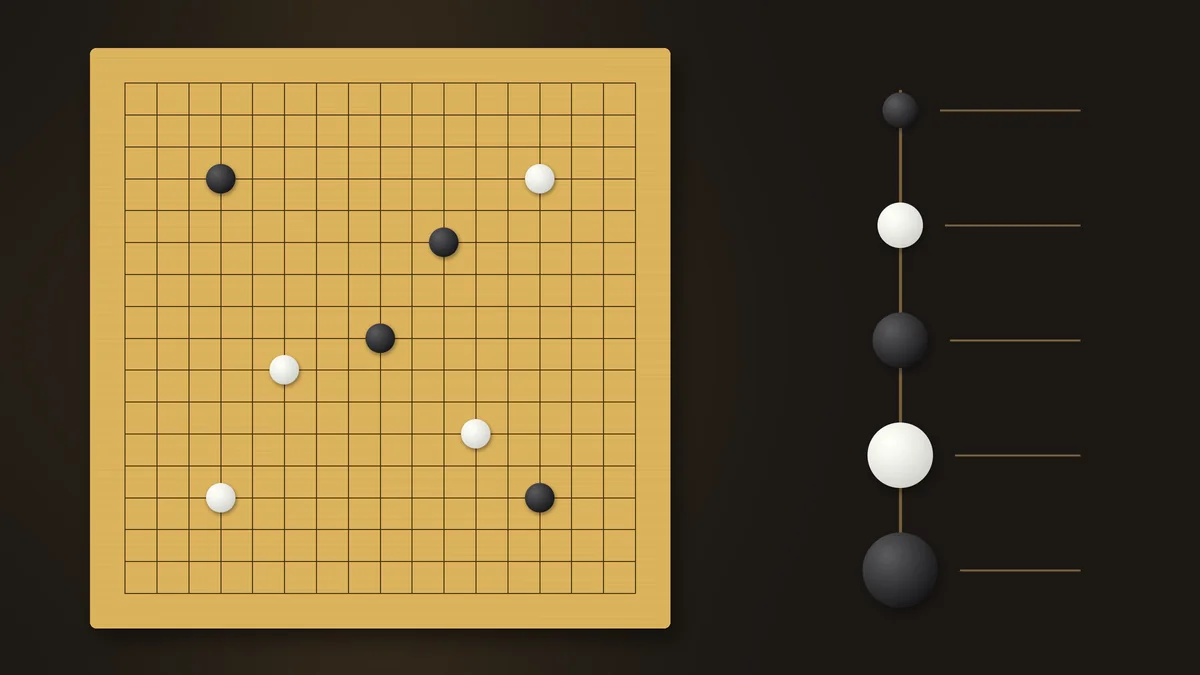
Go is often called the oldest board game still played in its original form. Nobody knows exactly when it was invented, but it has been played for at least 2,500 years, and the stones and the grid of an ancient game would be recognised at once by a player today. This guide follows the game from its beginnings in China to the present.
Origins in ancient China
Chinese tradition says that the legendary Emperor Yao invented Go to teach his son Danzhu to think. That is a story, not a record, but it shows how old people believed the game to be.
The earliest reliable written reference is in the Zuo Zhuan, a chronicle that mentions the game in an entry for the year 548 BCE. Confucius and Mencius also refer to it, so by their time Go was a familiar part of life among educated people. In those texts the game is called yi; the name weiqi, "the surrounding game", came into use later.
Early boards were smaller than today's. Archaeologists have found boards with 17 by 17 lines from the Han dynasty, and the 19 by 19 board became standard by about the Tang dynasty (618–907). During the same centuries the first books on strategy appeared, and Go took its place among the "four arts" of the cultivated person, together with the zither, calligraphy and painting. The Tang court even employed official Go players.
The road to Korea and Japan
Go travelled east with Chinese writing, Buddhism and court culture. It was being played on the Korean peninsula by about the fifth century. Korean chronicles tell of King Gaero of Baekje, whose passion for the game was exploited by a spy, the monk Dorim, in the year 475.
From Korea and China the game reached Japan, where it was established at court by the seventh and eighth centuries. Go boards from that period are still preserved in the Shosoin treasury in Nara. In the Heian period the game appears in classics such as The Tale of Genji and The Pillow Book, a sign of how fashionable it was among the nobility.
Japan's Go houses and the first professionals
The modern professional game took shape in Japan. In 1612 the Tokugawa shogunate began paying stipends to the strongest players, and four hereditary schools grew up: the Honinbo, Inoue, Yasui and Hayashi houses. They trained pupils, competed for the post of Meijin and played annual "castle games" in the presence of the shogun.
For two and a half centuries these houses pushed the game forward. Honinbo Dosaku (1645–1702) analysed the opening so deeply that he is still called a Go saint. Honinbo Shusaku (1829–1862) won nineteen castle games in a row, and his games are studied to this day. The rivalry between the houses produced opening theory, ranking by dan and a tradition of recording and commenting on games that every later generation inherited.
When the shogunate fell in 1868 the houses lost their income, and players had to find new support. Newspapers stepped in, sponsoring matches and printing the game records. In 1924 the Nihon Ki-in, the Japanese Go Association, was founded, and tournaments for titles such as the Honinbo replaced the old hereditary system.
The twentieth century: new ideas and new centres
In 1933 two young players, Go Seigen and Kitani Minoru, overturned the conventional opening with the "new fuseki", playing on high points and in the centre. Go Seigen, born in China and active in Japan, went on to beat every leading player of his day in a series of ten-game matches and is widely regarded as the greatest player of the century.
Until the 1980s Japan was the undisputed centre of the Go world, and talented players from Korea and China went there to study. Then the balance changed. China rebuilt its Go after 1949, and Nie Weiping's victories in the China–Japan Supermatches of the mid-1980s set off a Go boom at home. In Korea, Cho Namchul founded the association that became the Korea Baduk Association in 1945, and in 1989 Cho Hunhyun won the first Ing Cup, the richest of the new world championships.
International tournaments began in 1988 with the Fujitsu Cup and the Ing Cup. Japanese players won the first of them, Korean players dominated the 1990s and 2000s, led by Lee Changho and Lee Sedol, and from the 2010s Chinese and Korean players have shared most of the world titles.
Go in the West
Europeans had heard of Go from travellers, but few played it until the 1880s, when the German engineer Oskar Korschelt, who had learned the game in Japan, published a detailed description. Clubs followed in Germany and Austria. In the United States, Edward Lasker and his friends founded the American Go Association in 1935, and the European Go Federation was formed in 1957. Today there are clubs, national championships and Go servers that connect players in almost every country.
The age of AI
For decades Go was the game computers could not master. Programs that beat chess champions in the 1990s played Go at the level of a weak amateur. That changed suddenly. In March 2016 the program AlphaGo, developed by DeepMind, defeated Lee Sedol 4–1 in Seoul. A year later an improved version beat Ke Jie, then the world number one, 3–0.
Strong programs are now free and open to everyone, and professionals use them every day for study. AI has changed opening theory, revived moves once thought to be mistakes and made top-level analysis available to any learner. It has not ended human Go: tournaments, leagues and broadcasts continue, and players still sit down across a board, as they have for twenty-five centuries.
One game, many histories
Each country gave the game something of its own. To read on, see Go in China, Go in Japan, Go in Korea and Go in the United States, or meet the great players in Ten Legendary Go Players. If you would like to play the game itself, start with Learn Go.