Go in China: The History and Present of Weiqi
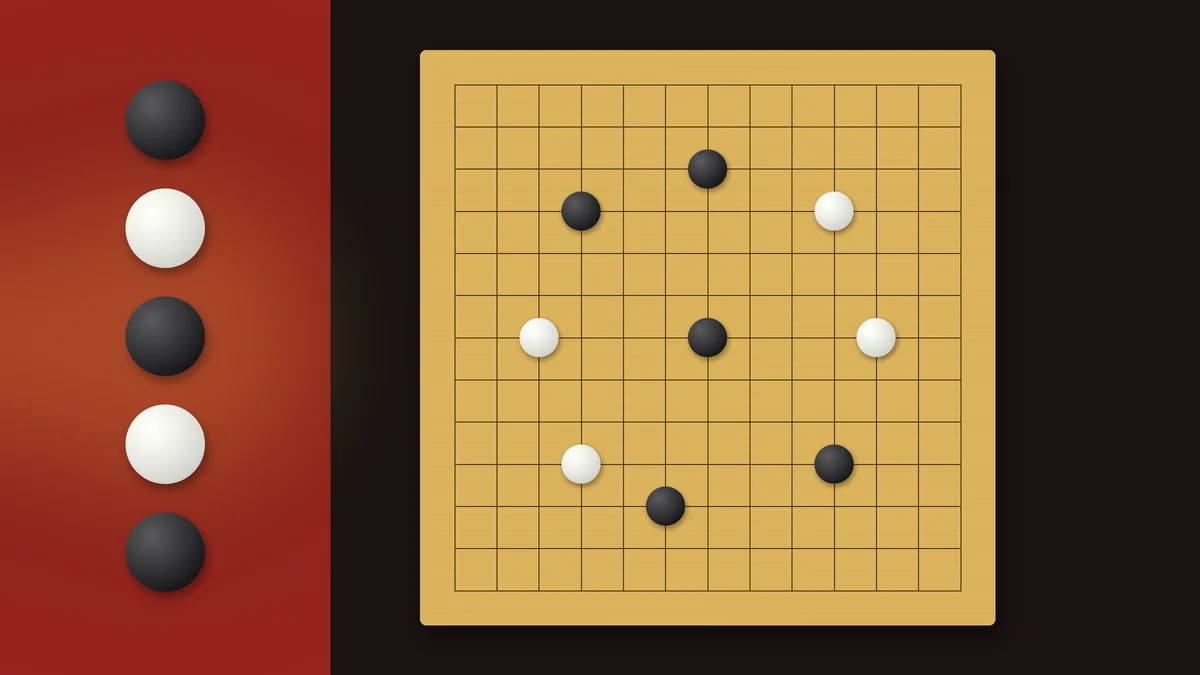
Go was born in China, where it is called Weiqi (围棋), "the surrounding game". For most of its history China was the only place it was played, and for long periods it was the country with the strongest players. In between came a decline so deep that Chinese masters could not compete with visitors from abroad. The recovery from that low point is one of the great stories of the modern game.
The classical game
Weiqi has been played in China for at least 2,500 years. The Zuo Zhuan mentions it in an entry for 548 BCE, and Confucius and Mencius refer to it as something their readers knew well. By the Tang dynasty (618–907) the board had settled at 19 by 19 lines, the court kept official players known as qi daizhao, and Weiqi was one of the "four arts" of the educated person, together with the zither, calligraphy and painting.
The Tang player Wang Jixin is traditionally credited with the Ten Golden Rules of Weiqi, short maxims such as "Greed does not bring victory" that players still quote. In the Song dynasty the Classic of Weiqi in Thirteen Chapters set out the theory of the game, and the oldest surviving collection of game records was compiled.
One feature of the old Chinese game was different from today's. Each game began with four stones already on the board, two black and two white, placed on the diagonally opposite corner star points. This fixed start produced a style built on fighting, and it remained the custom until the early twentieth century.
The masters of the Ming and Qing
Classical Chinese Weiqi reached its height in the seventeenth and eighteenth centuries. Guo Bailing, Huang Longshi, Fan Xiping and Shi Xiangxia are the names every Chinese player learns.
The most famous games of the era are the Danghu Ten Games, played in 1739 between Fan Xiping and Shi Xiangxia. Both were at the peak of their powers, and the games are full of fierce and precise fighting. They are still studied as the summit of the classical style.
After that generation the game declined. The late Qing dynasty was a time of war and disorder, patrons disappeared and no system existed to train new players. When Japanese professionals visited China in the early twentieth century, the best Chinese players needed handicap stones to compete. The four-stone starting position was abandoned and Chinese players began to study Japanese opening theory.
The greatest Chinese talent of those years made his career abroad. Wu Qingyuan, known by the Japanese reading of his name as Go Seigen, was born in Fujian in 1914, moved to Japan in 1928 and became the strongest player in the world.
Rebuilding after 1949
The People's Republic treated Weiqi as a sport and gave it state support. Marshal Chen Yi, a keen player, was its most important patron. Regular exchange matches with Japan began in 1960, and the Chinese Weiqi Association was founded in 1962. At first Chinese players lost heavily, but they learned quickly. In 1963 Chen Zude became the first Chinese player to defeat a Japanese 9-dan in an even game, and his name is linked with the "Chinese opening", a formation that went on to be played all over the world.
The Cultural Revolution interrupted everything. The national team was disbanded and players were sent to work in factories and on farms. Organised Weiqi resumed in the 1970s.
Nie Weiping and the supermatches
The player who changed how China saw itself at the board was Nie Weiping (1952–2026). He became national champion in 1975 and beat a series of Japanese professionals on a tour of Japan the following year.
In 1984 China and Japan began the Supermatches, a team knockout between the two countries. Japan was expected to win easily. Instead Nie, playing last for China, beat one top Japanese player after another and brought China victory in the first three contests, winning eleven games in a row. The matches were followed across the country, and millions of people took up the game. In 1988 Nie was awarded the honorary title Qisheng, "Go Sage". He later taught a generation of champions, among them Chang Hao and Gu Li, and remained the best-known figure in Chinese Weiqi until his death in Beijing in January 2026.
China introduced its professional dan ranks in 1982, and Rui Naiwei became the first woman in the world to reach 9-dan in 1988.
World champions
International championships began in 1988. Chinese players came close several times before Ma Xiaochun won two world titles in 1995, the first for a player from mainland China. For the next decade, however, the Korean player Lee Changho dominated, and Chinese players often lost to him in finals.
The tide turned in the 2000s. Chang Hao won the Ing Cup in 2005. Gu Li won eight world titles and fought a celebrated rivalry with Lee Sedol of Korea. The Chinese A League, founded in 1999, gave young professionals regular hard games and good incomes, and a very large pool of talent grew up. In 2013 all six major international titles decided that year were won by Chinese players, six different ones.
Ke Jie, born in 1997, won his first three world titles within a single year and went on to win eight. In May 2017, as the world number one, he played the program AlphaGo at Wuzhen and lost 0–3, the match that confirmed that machines had passed the best human players.
Chinese Go today
China has by far the largest number of strong professional players, and the competition among them is intense. The generation born around 2000 now leads: Ding Hao has won the LG Cup and the Samsung Cup, and Wang Xinghao, born in 2004, has risen to the top of the Chinese rankings and won a world title of his own. Their main rivals are the Korean players led by Shin Jin-seo, and the contest between China and Korea is the centre of international Go.
Weiqi is officially a sport in China. It was a medal event at the Asian Games in Guangzhou in 2010 and again at the Hangzhou Games, held in 2023. Children's Weiqi classes are common in Chinese cities, there are many private Weiqi schools, and tens of millions of people play. Top professionals train with AI programs every day, as they do everywhere.
Chinese rules
Rules differ slightly between countries. Under Chinese rules the score is counted by area: each side's living stones on the board plus the empty points they surround. Captured stones are not counted separately. The compensation for White is 7.5 points. In nearly every game the winner is the same as under Japanese and Korean territory counting, and the rules of play are the same.
Further reading
Compare this story with Go in Japan and Go in Korea, read the wider picture in The History of Go, or meet Nie Weiping and Ke Jie among the Ten Legendary Go Players. To learn the game itself, start with Learn Go.